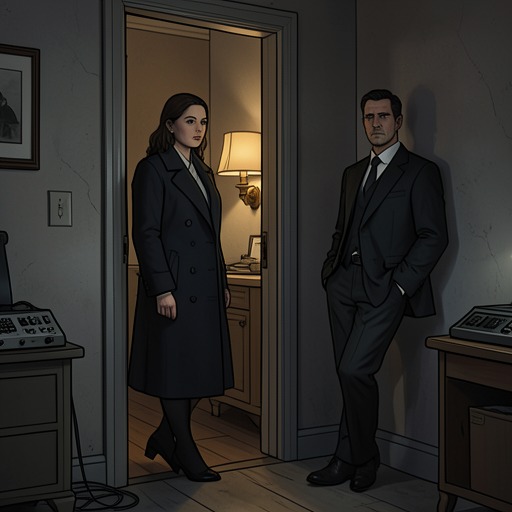
John Christow–Gerda Christow marriage
The HollowThe John Christow–Gerda Christow marriage is the central domestic relationship through which the novel tests the difference between loving a person and worshipping an image. John Christow values Gerda’s submission because it allows him to feel masterful and unimpeded, while Gerda builds her identity around his supposed nobility. The marriage therefore appears stable only while its unequal expectations remain unspoken. Once Veronica Cray re-enters John’s life and Gerda sees the falsity of the man she has worshipped, the relationship becomes the immediate emotional cause of John’s murder and the subsequent collective concealment of the truth.
Formation and Unequal Foundations
John’s decision to marry Gerda follows his rejection of Veronica Cray. Twelve to fifteen years earlier, he had been deeply in love with Veronica, but concluded that she would absorb his identity into her own ambitions. When she expected him to marry her and accompany her to Hollywood, he broke off their engagement, returned to London, began work with Radley, and married Gerda a year later. Gerda was unlike Veronica in every important respect: quiet rather than dazzling, accommodating rather than dominating, and willing to let John direct their shared life. John had presented himself as her protector, telling her that he would look after her and that she need not worry because he would take care of things.
The marriage thus begins with a decision John considers morally and practically correct, but it also begins with substitution. Gerda is chosen partly because she will not compete with his independence. John intends to live his own life, and Gerda’s character seems to promise that she will make few demands upon it. The contrast with Veronica remains embedded in the marriage even before Veronica returns: Gerda represents the compliant domestic order John believes he wants, while Veronica represents the consuming force from which he believes he has escaped.
Domestic Affection and Irritation
At the time of the main action, John is married to Gerda and has children with her, but his private response to the marriage is increasingly strained. He has become persistently tired, and this exhaustion feeds an irritability he cannot control. He recognizes that Gerda has much to endure from him, yet the very virtues that ought to secure affection provoke his ill humour. Her patience, unselfishness, readiness to subordinate her wishes, and reluctance to oppose him irritate him because they expose both her dependence and his own responsibility for the imbalance between them.
John’s resentment is particularly revealing because Gerda does not retaliate. She does not insist on her own opinion, maintain a separate line of action, or answer his sudden bursts of temper with resistance. Her submissiveness gives him the freedom he once wanted, but it also deprives the marriage of reciprocal pressure and recognition. He has selected the conditions that now oppress him. The relationship is not simply one in which a difficult husband mistreats a passive wife; it is a structure whose central qualities John helped create and then came to experience as a burden.
Gerda’s view is very different. She regards John as wonderful, an exceptionally clever doctor whose kindness and dedication distinguish him from ordinary people. She admires the work he performs for hospital patients even when it brings him no financial reward, and she believes that his brilliance will carry him to the top. Her pride is intensified by the belief that he could have married someone more brilliant but chose her despite her slowness, plainness, and lack of intellectual distinction. She interprets his authority as care and his mastery as protection, preserving an image of John as noble rather than confronting the ordinary selfishness within his conduct.
Work, Care, and the Marriage’s Blind Spot
John’s professional identity helps sustain the marriage’s unequal moral picture. In his consulting room he listens sympathetically, asks questions, gives directions, and leaves patients feeling strengthened. Yet when one patient departs, he forgets her almost entirely; his healing response has become automatic, an instinctive expenditure of energy rather than evidence of personal attachment. He is financially successful but bored by cases that offer only palliation, while his interest revives when he encounters a patient who seems to fight for life.
That patient is Mrs. Crabtree, whose poverty, exhausting labour, alcoholic husband, and unruly children do not extinguish her appetite for existence. John recognizes in her the same zest for life that he feels in himself. Their mutual investment gives his medical work excitement and a sense of adventure unavailable in routine private practice. His connection with Mrs. Crabtree also clarifies what Gerda cannot see: John’s deepest emotional energy is not necessarily directed toward women or marriage but toward the challenge of healing, experimentation, and active struggle against disease. Henrietta Savernake later tells Hercule Poirot that, if John had been asked which woman occupied his mind most, he might have named Mrs. Crabtree—not because of romantic desire, but because his work mattered to him more than conventional love.
This professional vitality makes John’s domestic detachment more painful. Gerda sees the celebrated doctor who spends himself for others and transfers that public nobility into the private sphere. She does not distinguish between the automatic compassion of the clinician, the exhilaration of the medical experimenter, and the emotional generosity required of a husband. John’s reputation therefore becomes part of the marriage’s protective illusion: the world’s admiration confirms Gerda’s worship, while his private impatience remains difficult for her to interpret as evidence against him.
Veronica, Henrietta, and the Collapse of Trust
John’s past with Veronica Cray exposes the instability beneath the marriage. When Veronica returns, she assumes that marriage, children, and legal arrangements cannot prevent her from reclaiming him. John rejects her and insists that their lives have nothing to do with each other, but his encounter with her nevertheless reactivates a past he had treated as closed. Gerda sees John following Veronica and realizes that his former attachment was not emotionally meaningless. What she had believed to be entirely over becomes, in her perception, proof that the whole structure of her marriage has been false.
John’s relationship with Henrietta Savernake reveals a different contradiction. Henrietta’s qualities are not the same as Gerda’s, yet John wants from her the same assurance that she will not obstruct his life. What angers him is her unswerving rectitude where he is concerned. Henrietta understands that their affair is not a simple, mutual romance: John fears that love will distract him from his work, so he tries to keep the relationship light and easy, treating it as an affair that should not acquire controlling emotional weight. Henrietta is not content merely to occupy that limited place, but she remains bound to him by love.
The marriage is consequently triangulated among John, Gerda, and the women who represent incompatible versions of intimacy. Veronica threatens to possess John; Henrietta refuses to abandon moral clarity; Gerda yields herself to him so completely that she mistakes dependence for proof of his greatness. John moves among these relationships while imagining that he alone can define their limits. His failure to understand the emotional consequences of that control leaves Gerda particularly vulnerable when the idealized image of him breaks.
Murder, Protection, and Aftermath
Gerda’s discovery is not merely that John once loved Veronica. She believes that everything she thought he was has become a lie. She had trusted him as though he were God and regarded him as the noblest and finest man in the world. Henrietta recognizes the resulting figure as a worshipper whose blind devotion has been thrown back upon itself: disillusionment does not produce calm knowledge but a dangerous reversal of faith. Gerda tells Henrietta that she could not bear the collapse and had to kill John.
The murder is planned with deliberate attention to forensic confusion. Gerda knows that the police may identify which gun fired a bullet. After Sir Henry Angkatell shows her how to load and fire a revolver, she intends to use two weapons: one to shoot John and another to leave in her own hand. If the weapon found with her could not have fired the fatal bullet, investigators might conclude that she was innocent. Her apparent slowness becomes part of the disguise; she understands that people mistake passivity and staring for stupidity.
The marriage does not end with the shooting because Henrietta interprets John’s final appeal as an instruction to protect Gerda. Hercule Poirot eventually sees that the crime scene has been staged and that Gerda’s theatrical manner is deliberate, but he also discovers that Henrietta’s ingenuity and the Angkatell family’s assistance have complicated the investigation. Henrietta explains that John loved Gerda more deeply than he understood, perhaps more deeply than he loved Veronica or Henrietta, because Gerda belonged to him and he valued what he regarded as his own. His last word, “Henrietta,” therefore functions for her as a request to shield Gerda from the consequences of the act.
Gerda survives the immediate crisis but loses the husband she had idealized and the moral world organized around him. In hospital, Mrs. Crabtree remembers John not as a flawless domestic hero but as a lively doctor who encouraged her through painful treatment, treated her as tough, and made her feel that together they were contributing to medical history. Her recollection supplies a final counterpoint to Gerda’s worship: John was neither the saint she imagined nor merely the adulterous figure suggested by scandal. He was a forceful, imperfect man whose capacity to animate patients and dominate those close to him belonged to the same character. The marriage’s tragedy lies in Gerda’s inability to survive that contradiction until the truth arrives in its most destructive form.